Efficient Methods for Carbon Dioxide Capture
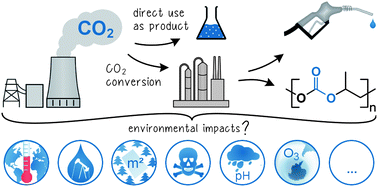
As concerns about climate change intensify, the focus on mitigating carbon emissions has become increasingly urgent. Among the various strategies, carbon dioxide capture emerges as a critical component in reducing atmospheric CO2 levels. This article explores efficient methods for capturing carbon dioxide, highlighting advancements and technologies that are making significant strides in this field. By effectively capturing CO2, these methods help mitigate the environmental impact of industries and contribute to global sustainability efforts.
Understanding Carbon Dioxide Capture
The process of carbon dioxide capture involves trapping CO2 emissions from sources like power plants and industrial processes before they reach the atmosphere. The captured carbon can then be stored or utilized in various applications. Given its potential to significantly reduce greenhouse gas emissions, carbon dioxide capture is a critical component of modern environmental strategies.
Types of Carbon Dioxide Capture Methods
Pre-combustion Capture
Pre-combustion capture involves removing carbon dioxide from fossil fuels before combustion. This method is often used in integrated gasification combined cycle (IGCC) plants.
- Fossil fuels are converted into a gas mixture containing hydrogen and carbon monoxide.
- Carbon monoxide is then converted into CO2, which is captured and separated.
- The remaining hydrogen can be used as a clean energy source.
Post-combustion Capture
This method captures CO2 emissions after the combustion of fossil fuels. It is widely applicable to existing power plants and industrial facilities.
- Flue gases are treated with solvent-based systems to separate CO2.
- Amine-based solvents are commonly used for this separation process.
- This approach is advantageous for retrofitting existing plants.
Oxy-fuel Combustion
Oxy-fuel combustion involves burning fossil fuels in oxygen rather than air, producing a flue gas that is primarily water vapor and CO2, which can be captured easily.
- Reduces the volume of flue gas, leading to better efficiency in capture processes.
- Generates high-purity CO2 suitable for storage or utilization.
- Can be integrated into new or existing power plants.
Advancements in Carbon Capture Technologies
Technological advancements are continuously improving the efficiency and cost-effectiveness of carbon capture processes. Innovations in material science and process engineering are leading to more efficient capture methods.
- Adsorption technologies: These involve materials that can selectively capture CO2 molecules from gas mixtures.
- Membrane technologies: Utilize permeable membranes to separate CO2 from other gases.
- Biological approaches: Leverage microorganisms that naturally absorb CO2 during their metabolic processes.
Challenges and Future Directions
While significant progress has been made, challenges remain in making carbon capture technologies more accessible and economically viable. Continued research and development are essential to overcome these hurdles:
- Cost reduction: Finding ways to lower the costs associated with capture technologies is crucial for widespread adoption.
- Scalability: Solutions need to be scalable to address emissions from large industrial sources effectively.
- Regulatory frameworks: Policies that incentivize carbon capture can accelerate its integration into existing infrastructure.
As the world continues to seek sustainable solutions, the evolution of carbon capture technologies represents a promising path toward reducing greenhouse gas emissions and combating climate change.